
Everything About IVF with Donor Egg
In cases where couples face the problem of infertility, several underlying conditions like hormonal imbalance, ovarian failure, or even severe Menstrual Cramps could be the first signs of a problem in reproduction. One of the most effective ways of overcoming such problems is IVF with Donor Egg.
For women who are not able to conceive using their own eggs, IVF with Donor Egg is a ray of hope that could help them experience pregnancy.
Learning more about IVF with Donor Egg can help women make confident decisions about their reproductive life.
What is IVF with Donor Egg?
IVF with Donor Egg is a fertility procedure where eggs from a healthy donor are fertilized with the sperm of the partner (or donor sperm) in a laboratory. The embryo is then transferred into the uterus of the intended mother.
Unlike traditional IVF, IVF with Donor Egg is advised for a woman who:
- Has poor egg quality
- Has premature ovarian failure
- Is of advanced maternal age
- Has genetic disorders
- Has failed previous IVF cycles
This Infertility Treatment has helped thousands of women become mothers.
Who May Need IVF with Donor Egg?
Women who can consider IVF with Donor Egg are:
- Women above 38-40 years with low ovarian reserve
- Women with recurrent IVF failure
- Women with severe endometriosis
- Women with genetic disorders
- Women who have undergone chemotherapy
In some cases, women with Menstrual Disorder Treatment issues may find that their ovarian reserve is low, and IVF with Donor Egg becomes an option.
How Does IVF with Donor Egg Work?
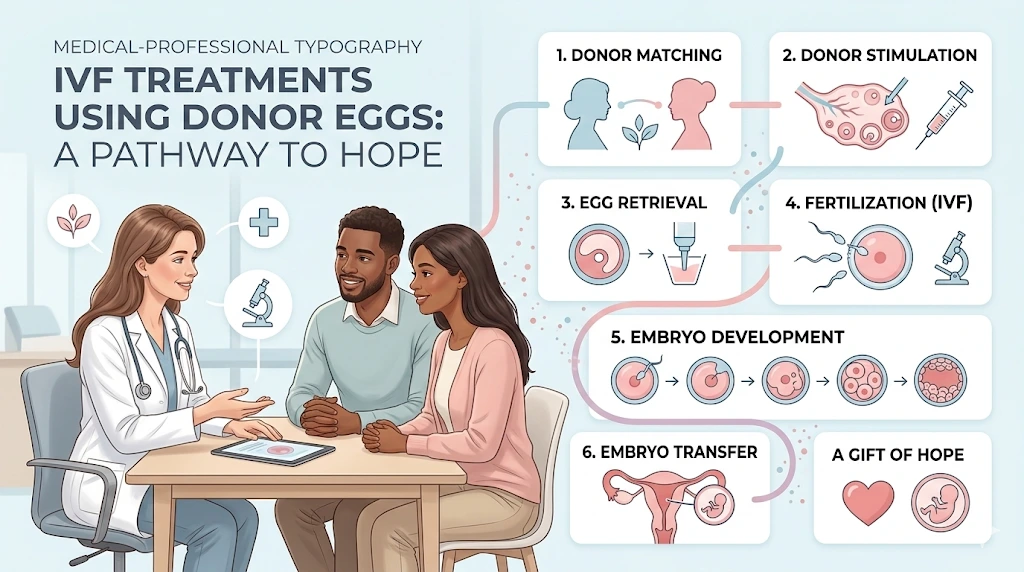
The steps involved in IVF with Donor Egg are as follows:
- Donor Selection
The donor is screened medically, hormonally, and genetically.
- Egg Retrieval
The healthy eggs are obtained from the donor.
- Fertilization
The eggs are fertilized in the laboratory with sperm.
- Embryo Transfer
A healthy embryo is transferred into the uterus of the recipient.
- Pregnancy Monitoring
After the successful transfer of the embryo, regular Prenatal Care starts.
Women undergoing IVF with Donor Egg still experience pregnancy normally in their own body after the embryo transfer.
Is IVF with Donor Egg Safe?
Yes, IVF with Donor Egg is a safe procedure when done under expert care. However, like any other medical procedure, it has to be closely monitored.
The safety aspects are as follows:
- Hormonal equilibrium
- Healthy uterus
- Correct embryo selection
- Regular medical check-up
Qualified gynecologist doctors in Indore make sure that each and every step of IVF with Donor Egg is medically supervised.
Emotional Aspects of IVF with Donor Egg
Making the decision to have IVF with Donor Egg can be very emotionally challenging. Some women are concerned about biological relatedness, social acceptance, or emotional attachment.
However, studies have found that mothers who have IVF with Donor Egg develop the same level of emotional attachment to their babies. Pregnancy hormones and maternal attachment are very influential in the development of emotional attachment.
Counseling is often advised prior to the initiation of IVF with Donor Egg.
IVF with Donor Egg and Menstrual Health
Women with severe Menstrual Cramps, irregular menses, or hormonal imbalance issues may experience ovulation difficulties in the future. Timely Menstrual Disorder Treatment may sometimes avert severe fertility issues.
But if the ovarian reserve is drastically diminished, IVF with Donor Egg is one of the most effective options available.
Role of Laparoscopic Surgery and Hysteroscopy Surgery
Before embarking on IVF with Donor Egg, the following diagnostic tests may be advised by doctors:
- Laparoscopic Surgery to assess the presence of endometriosis or fibroids
- Hysteroscopy Surgery to assess the uterus
These tests are essential to ensure that the uterus is in good health to carry the pregnancy after IVF with Donor Egg.
Success Rate of IVF with Donor Egg
The success rate of IVF with Donor Egg is relatively higher compared to conventional IVF in older women. This is because the eggs from donors are from younger and healthier women, and hence the quality of the embryos is likely to be good.
The following are the factors that influence success in IVF with Donor Egg:
- Uterine Health
- Hormonal Balance
- Lifestyle Habits
- Appropriate Medical Advice
Timely Infertility Treatment improves outcomes significantly.
Pregnancy After IVF with Donor Egg
After embryo transfer, the pregnancy progresses like any natural pregnancy. Regular Prenatal Care includes:
- Ultrasound scans
- Blood tests
- Nutritional monitoring
- Blood pressure checks
Women who conceive through IVF with Donor Egg should follow medical advice strictly to ensure healthy fetal development.
IVF with Donor Egg and Breast Health
Hormonal therapy used during IVF with Donor Egg may temporarily cause breast tenderness. Routine Breast Cancer Screening is important for women in appropriate age groups before fertility treatments.
Maintaining overall reproductive and breast health ensures safer fertility planning.
Teenage Girls and Fertility Awareness
Although IVF with Donor Egg is mainly for women with infertility issues, teenage girls should know the significance of menstrual health early on.
Hormonal imbalance, severe Menstrual Cramps, or irregular menses can sometimes impact fertility. Early consultation with an Indore gynaecologist is essential for preventive measures.
Lifestyle Tips to Improve IVF with Donor Egg Success
Women preparing for IVF with Donor Egg should:
- Maintain healthy weight
- Avoid smoking and alcohol
- Reduce stress
- Eat nutrient-rich foods
- Get adequate sleep
A healthy body improves implantation and pregnancy outcomes.
Common Myths About IVF with Donor Egg
Myth 1: The baby will not bond with the mother
Truth: Emotional bonding is developed during pregnancy and after birth.
Myth 2: IVF with Donor Egg is unsafe
Truth: When done under expert care, it is a medically safe procedure.
Myth 3: Only older women need IVF with Donor Egg
Truth: Even younger women with ovarian failure may require it.
When to Consult a Specialist?
You should visit gynecologist doctors in Indore if:
- You are unable to conceive after 1 year of trying
- You have irregular cycles
- You experience severe Menstrual Cramps
- You had repeated miscarriages
- You are above 35 and planning pregnancy
Early evaluation prevents delay in appropriate Infertility Treatment.
Final Thoughts
Motherhood is a very emotional experience, and infertility can be a physically and emotionally taxing process. However, thanks to the latest medical advancements, IVF with Donor Egg has revolutionized the field of reproductive medicine.
Regardless of whether the cause of infertility is Ovarian Failure, Hormonal Imbalance, or issues that can be diagnosed by Laparoscopic Surgery or Hysteroscopic Surgery, IVF with Donor Egg is a ray of hope.
Women should never overlook severe Menstrual Cramps or irregular menses, as early treatment can lead to better long-term pregnancy outcomes.
With the right medical advice, emotional care, and a planned Prenatal Care program, pregnancy after IVF with Donor Egg can be a safe and satisfying experience.