
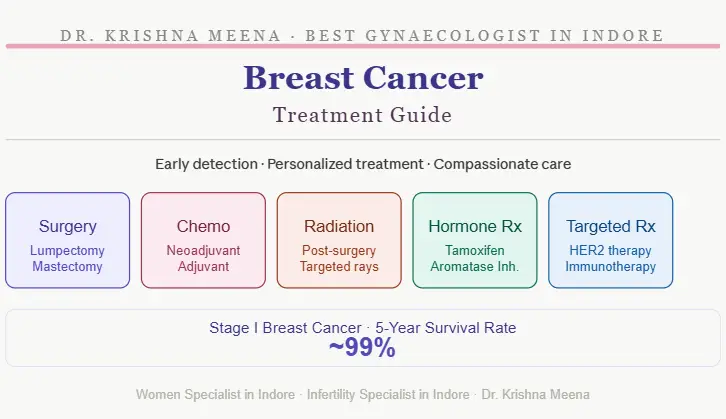
Introduction: Why Every Woman Needs to Know About Breast Cancer
Let’s talk about something important — something that affects 1 in 8 women globally, yet remains surrounded by fear and silence. Breast cancer is one of the most common cancers among women, but here’s the truth: when caught early and treated by an expert, survival rates can be as high as 99%.
If you or someone you love has recently been diagnosed, or if you simply want to stay informed, this guide is for you. Dr. Krishna Meena, a trusted Best Gynaecologist in Indore with years of experience in women’s health, has compiled this comprehensive resource to help you understand breast cancer — from the first warning signs to the most advanced treatment options available today.
Whether you are in Indore or anywhere across Madhya Pradesh, having access to the right information and the right specialist can truly change outcomes. So, let’s get started.
What Is Breast Cancer?
Breast cancer occurs when cells in the breast tissue grow uncontrollably, forming a tumor. While it predominantly affects women, men can develop breast cancer too, though rarely.
Types of Breast Cancer
There are several distinct types, and understanding them helps in choosing the right treatment:
- Ductal Carcinoma In Situ (DCIS): A non-invasive form confined to the milk ducts
- Invasive Ductal Carcinoma (IDC): The most common type, where cancer spreads beyond the ducts
- Invasive Lobular Carcinoma (ILC): Originates in the milk-producing lobules
- Triple-Negative Breast Cancer: Lacks estrogen, progesterone, and HER2 receptors — often more aggressive
- HER2-Positive Breast Cancer: Overexpresses the HER2 protein and tends to grow faster
- Inflammatory Breast Cancer: A rare but aggressive form affecting the skin of the breast
As Dr. Krishna Meena explains to her patients, knowing your cancer type is not just technical jargon — it is the foundation of your entire treatment plan.
Recognizing Breast Cancer: Symptoms You Should Not Ignore
Many women underestimate subtle changes in their bodies. However, early recognition is life-saving. Watch out for these signs:
- A new lump or mass in the breast or armpit
- Unexplained swelling of part or all of the breast
- Skin dimpling, puckering, or thickening (resembling orange peel)
- Nipple discharge (other than breast milk), especially if bloody
- Inversion or retraction of the nipple
- Persistent breast pain or tenderness that does not go away
- Redness, scaling, or flaking of the nipple or breast skin
- Changes in the size or shape of the breast
Furthermore, if you notice any of these signs, consult a Women Specialist in Indore immediately. Early-stage breast cancer often has no pain at all — which is why regular screening is non-negotiable.
Diagnosis: How Breast Cancer Is Detected
Getting an accurate diagnosis is the most important first step. Dr. Krishna Meena follows a systematic, evidence-based diagnostic approach:
Step-by-Step Diagnostic Process
Step 1: Clinical Breast Examination – The specialist performs a physical examination of the breasts and lymph nodes.
Step 2: Mammography – A mammogram is a low-dose X-ray specifically designed to detect abnormalities in breast tissue — often before any lump can be felt.
Step 3: Ultrasound – Breast ultrasound helps distinguish between solid masses and fluid-filled cysts. It is particularly useful for younger women with denser breast tissue.
Step 4: MRI (Magnetic Resonance Imaging) – An MRI provides more detailed images and is recommended for high-risk women or for assessing the extent of cancer.
Step 5: Biopsy – A biopsy is the only definitive way to confirm breast cancer. The tissue sample is examined to determine the cancer type, grade, and receptor status.
Step 6: Staging – Staging (I through IV) determines how far the cancer has spread, which directly guides the treatment plan.
Dr. Krishna Meena, who is also recognized as a leading Infertility Specialist in Indore, uses advanced diagnostics to ensure no detail is missed during evaluation.
Breast Cancer Treatment Options: A Comprehensive Overview
Treatment for breast cancer is never one-size-fits-all. Based on the type, stage, and individual health profile, a combination of therapies is usually recommended.
1. Surgery
Surgery is often the first line of treatment.
- Lumpectomy: Removes only the tumor and a small margin of surrounding tissue — also called breast-conserving surgery
- Mastectomy: Removes the entire breast — recommended when the tumor is large or when multiple areas are affected
- Sentinel Node Biopsy: Identifies whether cancer has spread to lymph nodes
2. Chemotherapy
Chemotherapy uses powerful drugs to destroy cancer cells or stop them from dividing. It can be administered before surgery (neoadjuvant) to shrink the tumor or after surgery (adjuvant) to eliminate remaining cells.
Common side effects include hair loss, fatigue, and nausea — but these are manageable with modern supportive care protocols.
3. Radiation Therapy
Radiation targets and kills cancer cells using high-energy rays. It is typically used after surgery to reduce the risk of recurrence, particularly after a lumpectomy.
4. Hormone Therapy (Endocrine Therapy)
For hormone receptor-positive breast cancers, medications like Tamoxifen or aromatase inhibitors block hormones that fuel cancer growth. This therapy is generally taken for 5 to 10 years after primary treatment.
5. Targeted Therapy
Targeted therapies like Trastuzumab (Herceptin) specifically attack HER2-positive cancer cells while sparing normal cells — making treatment more precise and less toxic.
6. Immunotherapy
Immunotherapy helps the body’s immune system recognize and attack cancer cells. It is increasingly being used for triple-negative breast cancer in combination with chemotherapy.
Benefits of Early Detection and Timely Treatment
Choosing to act early brings several critical advantages:
- Higher survival rates: Stage I breast cancer has a 5-year survival rate of nearly 99%
- More treatment options: Early-stage cancer often allows breast-conserving surgery instead of full mastectomy
- Lower treatment intensity: Less aggressive treatment with fewer side effects
- Better quality of life: Shorter treatment duration and faster recovery
- Reduced recurrence risk: Timely intervention reduces the chance of cancer returning
- Cost-effective care: Early-stage treatment is significantly less expensive than advanced-stage management
Dr. Krishna Meena consistently emphasizes to her patients — both as a Best Gynaecologist in Indore and as a Women Specialist in Indore — that no symptom is “too small” to discuss with your doctor.
Common Mistakes Women Make Regarding Breast Cancer
Even well-informed women sometimes fall into these traps. Avoiding them can genuinely save lives:
- Ignoring lumps that are not painful: Painless lumps are among the most common presentations of breast cancer — do not dismiss them
- Skipping mammograms due to fear: Anxiety about the result is understandable, but early detection is always better than late diagnosis
- Self-diagnosing with Google: No online search can replace a professional evaluation by an expert like Dr. Krishna Meena
- Delaying treatment after diagnosis: Every week of delay in treatment matters — act promptly
- Stopping treatment midway: Some patients stop therapy when side effects become difficult — this is dangerous and can lead to resistance or recurrence
- Assuming family history is the only risk factor: 70% of breast cancer patients have no family history of the disease
- Neglecting follow-up care: Survivorship care and regular monitoring are essential even after successful treatment
Breast Cancer Risk Factors: Who Is Most at Risk?
While any woman can develop breast cancer, certain factors increase the risk:
- Age: Risk increases significantly after age 40
- Family history and genetics: BRCA1 and BRCA2 gene mutations substantially elevate risk
- Dense breast tissue: Makes mammograms harder to read and increases susceptibility
- Hormonal factors: Early menstruation, late menopause, hormone replacement therapy
- Lifestyle factors: Obesity, alcohol consumption, lack of physical activity, and smoking
- Reproductive history: Having children after 35 or never breastfeeding may slightly increase risk
- Previous radiation therapy: Especially if received during childhood or young adulthood
Understanding your risk profile helps Dr. Krishna Meena — your Infertility Specialist in Indore and women’s health expert — create a personalized screening and prevention strategy.
Practical Breast Self-Examination: A Step-by-Step Guide
Regular self-examination is a powerful habit every woman should adopt. Here is how to do it correctly:
Step 1: Stand in front of a mirror with your arms at your sides. Look for any visible changes.
Step 2: Raise both arms overhead and check again for changes in contour, skin texture, or nipple position.
Step 3: Lie down. Place your right arm behind your head. Use the pads of your left fingers to check the right breast using a circular motion.
Step 4: Move in a systematic pattern — from the outer edge inward — covering the entire breast, including the nipple and armpit area.
Step 5: Repeat for the left breast. Also check for any discharge by gently squeezing each nipple.
Frequency: Perform this once a month, ideally a few days after your menstrual cycle ends when breasts are least tender.
Tools and Technologies Used in Modern Breast Cancer Treatment
Modern oncology has advanced significantly. Here are the key tools and technologies available:
| Tool / Technology | Purpose |
|---|---|
| 3D Mammography (Tomosynthesis) | More detailed breast imaging with fewer false positives |
| PET-CT Scan | Detects if cancer has spread to other organs |
| Liquid Biopsy | Blood test to detect circulating tumor DNA |
| Oncotype DX Test | Predicts benefit of chemotherapy in early-stage cancer |
| Robotic Surgery | Minimally invasive, precise surgical procedures |
| Radiation Boost Therapy | Targeted radiation to reduce recurrence after lumpectomy |
Dr. Krishna Meena: Experience, Expertise & Compassionate Care
Dr. Krishna Meena is widely regarded as one of the most trusted Women Specialists in Indore. With expertise spanning gynecology, infertility treatment, and women’s oncology, she brings a uniquely comprehensive perspective to every patient’s care journey.
As a leading Infertility Specialist in Indore and Best Gynaecologist in Indore, Dr. Krishna Meena combines clinical excellence with compassionate patient communication — ensuring that every woman who walks through her door feels informed, supported, and empowered to make the best decisions for her health.
Her patient-centered approach includes:
- Personalized cancer risk assessment
- Genetic counseling for high-risk families
- Multidisciplinary treatment coordination
- Nutritional and psychological support guidance
- Clear communication at every stage of treatment
Conclusion: Your Health, Your Priority — Take Action Today
Breast cancer is serious, but it is also highly treatable — especially when detected early. Throughout this guide, we have covered everything from recognizing early symptoms to understanding the full spectrum of breast cancer treatment options available today.
The most important takeaway is this: do not wait. Whether you have noticed a change, are due for a mammogram, or simply want a professional consultation, now is the right time to act.
Dr. Krishna Meena, the Best Gynaecologist in Indore and a trusted Women Specialist in Indore, is here to guide you every step of the way. From diagnosis to recovery, her expertise ensures that you receive the most advanced, evidence-based, and compassionate care available.
Book your consultation with Dr. Krishna Meena today. Your health is worth it.
Frequently Asked Question
1. What are the first signs of breast cancer I should watch for?
The first signs of breast cancer often include a painless lump in the breast or armpit, changes in breast size or shape, skin dimpling, nipple discharge, or nipple inversion. If you notice any of these changes, consult Dr. Krishna Meena or a Women Specialist in Indore immediately for evaluation.
2. At what age should women start getting mammograms?
Women with average risk should begin annual mammogram screening at age 40. However, if you have a family history of breast cancer or known BRCA gene mutations, Dr. Krishna Meena — Infertility Specialist in Indore and women’s health expert — may recommend starting screening earlier, sometimes as young as 25–30 years.
3. Is breast cancer curable?
Yes, breast cancer is highly curable, especially when detected at an early stage. Stage I breast cancer has a nearly 99% 5-year survival rate. Even advanced stages are increasingly manageable with modern treatment options including targeted therapy and immunotherapy. Early diagnosis remains the most critical factor in successful outcomes.
4.
Dr. Krishna Meena, the Best Gynaecologist in Indore, tailors each treatment plan based on the cancer’s type, stage, hormone receptor status, HER2 status, and the patient’s overall health and personal preferences. She coordinates with oncologists, radiologists, and surgeons to ensure a comprehensive, multidisciplinary approach for every patient.
5.
Yes, certain breast cancer treatments — particularly chemotherapy — can impact fertility. As a specialized Infertility Specialist in Indore, Dr. Krishna Meena offers fertility preservation counseling and options such as egg or embryo freezing before treatment begins. This ensures that young women do not have to choose between cancer treatment and their future family planning goals.